You can see he looks apprehensive, stressed right here. And it’s because he hears a siren, presumably police. He’s on high alert because he’s just waiting for the day that those sirens come for him.
And here he is after the (police) car with the siren passes by him. He’s relieved, a little shaken. He swallows, breathes, and gathers himself a little.
ANNNDDD then he spots the guy across the street who’s staring at him, and you can see his stomach drop and he visibly tenses again. It’s a nightmare come to life. And I’m saying “a nightmare” because sadly, this probably isn’t his worst nightmare.
And his breathing picks up, and he looks so afraid, his tiny bit of peace, whatever peace he can get, is shattered. He always knew this day would come, but he had hoped he’d have more time. And it breaks my fucking heart.
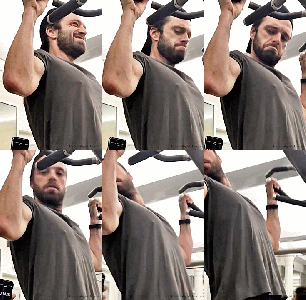
And I have to say biiiiiggg KUDOS to Sebastian Stan for acting out all the minutiae of Bucky’s facial expressions and body language. Because HOLY SHIT there was a lot of stuff going on in Bucky’s internal dialogue.
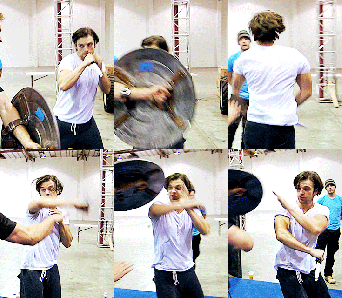
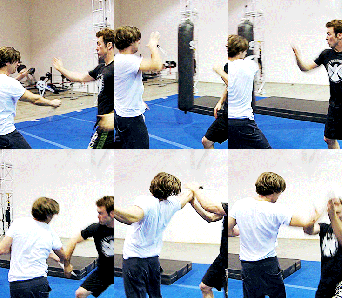
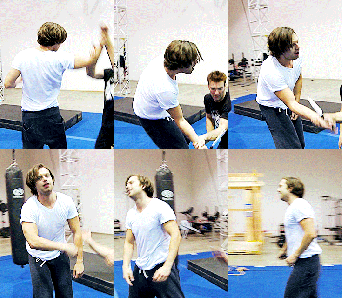
I choose to reimagine this as Bucky Barnes getting his battle groove back on, after he’s gotten de-programmed and in a better headspace as far as recovery is concerned.
Because, of course, he’s not about to leave his trouble-prone punk alone. Seriously. The last time this happened, Steve flew a plane into the Arctic, got frozen and then, a lot later, did things like jumping out of planes with no fucking parachutes and jumping out of elevators with just the shield to take the force of the fall.
He and Steve had a Talk about the Elevator Incident.
It ended up traumatizing Tony Stark because WHY OH WHY ARE SUPER SOLDIERS MAKING BLANKET FORTS IN MY WORKSHOP AND HOW THE HELL DID MY BABIES END UP CRUSHING ON YOU BOTH AND JARVIS I THOUGHT YOU STILL HAD THAT CRUSH ON OAKENSHIELD WHY IS THIS MY LIFE WHYYYYYY.
So anyway, Bucky’s retraining.
Steve either joins him or is in the background, trying not to end up getting aroused over this whole business, because hey, his sergeant in battle mode is a beautiful thing and the best way to get himself under control is either to grab his sketchpad or join in the fun.
Okay, so maybe joining in the fun isn’t a great idea towards the whole self-control thing.
I know Steve is really talented with his shield and is like an expert with it
but just imagine him smacking it in his face
or tripping over it
or waking up in the middle of the night and he shuffles off to the bathroom only to step on the edge of the shield and it smacks him in the shin and he curses loudly enough to wake up the other Howling Commandos who just sit up and start laughing at the way Steve is holding onto his leg and swearing
Seriously, though, super-soldier or not, watching Steve learn to use his shield must’ve been A+ comedy!
Steve throws it at some HYDRA goons but misses them by a mile and it bounces off a wall and flies out through a window, and Steve is just standing there, whoops, while Bucky rolls his eyes, takes out the enemies with his rifle, and jogs back outside to fetch the shield.
Steve hasn’t learnt the ctrl+c to crouch move yet; he holds the shield in front of his face and a HYDRA sniper shoots him in the thigh. Bucky facepalms because Steve you idiot, the shield only protects the bits of you actually behind it. Eventually, Steve masters the art of hiding his entire body behind the shield, tortoise-style, by ducking and having Bucky chuck pebbles at whatever parts of him are sticking out – of course Bucky has a wicked good aim and an even more wicked sense of humour, and Steve ends up with some rather embarrassing bruises.
The Commandos are on a stealth mission to infiltrate a secret HYDRA base, except the shield slips, falls, and does that rolling-metal-lid-dropped-on-the-ground sound like clang!!-grooiinnng-rooiinng-ooiinnnng-rnnnng-rrnng-rrnng-rrnng until Steve puts his foot on it. Everyone stops and just stares at him.
Also, my personal headcanon is that Steve once bet the shield in a hand of poker and Bucky won it. So it’s actually been Bucky’s shield since October 1944, Steve’s just borrowing it.
some things I’ve found useful for distinguishing between tasks where I’m willpower-constrained and tasks where I’m executive function-constrained:
if I’m willpower-constrained, incentives help. “If I finish this in the next hour, I can go get ice cream and walk along the pier” makes me more likely to finish it. Remembering that my work is highly valued and that people are excited to see the results helps. “I get paid a lot of money to do this” and “this will be helpful to people” and “I promised someone I’d get this done today” are all motivating. Narratives about “just buckle down and get the job done” help. Thinking to myself “sure, you don’t wanna. I don’t care. This has to happen, and we’re the person to do it” makes the task more likely to get done. Reframings are really powerful: “I have an hour to get these done” is a lot more effective than “I have to work on this for the next hour”.
(Notice that all of these are defined entirely in terms of “makes the task more likely to get done”, without any reference to my internal states. This is on purpose. Internal states are confusing. I suspect I’m often wrong about whether something is ‘helpful’ if I measure in any terms other than ‘does the task get done’.)
If I’m executive function-constrained, incentives don’t help. “If you get this done you can have ice cream and a walk” results in staring sadly at my computer screen thinking about the nice walk I’m missing out on. Believing my work is important and valued is actively unhelpful: it makes me go ‘ugh, all those people are expecting stuff to happen, but stuff is failing to happen, I‘m terrible.’ Telling my brain it has a very small, very constrained task is helpful: “I will try this for five minutes and then I’ll give up if I want to”. Having someone literally look over my shoulder to check whether I’m doing the task or something else is helpful. Caffeine helps. Food helps. Reasonably often it is the case that nothing helps, and I should give my brain a break. This is hard to do, because sometimes the thing really needs to happen. It’s hard to internalize “if I’m not going to get the thing done either way, it’s better to not get it done and rest my brain and not be miserable than to not get it done, further dig my brain into debt, and be miserable”.
For a while after getting on meds I thought that willpower was fake, and was just people misunderstanding what it’s like internally to be unable to do stuff. I don’t think that’s accurate. Willpower is sometimes a thing, it’s just overdiagnosed, and the approaches that work for it really don’t work for other reasons you might be failing to do stuff.
This was fascinating and also disappointing to learn, once I got over the initial spike in motivation about two weeks after starting Adderall. I was suddenly able to do things but I still had to develop discipline. Terrible.
I feel like something is possibly missing from this dichotomy. On at least some tasks, I’m…. surgency constrained? Interest constrained? Energy constrained? Curiosity constrained? Passion constrained? I’m not sure how to name it.
When I’m willpower constrained, what helps is: incentives, valuable work relevant to my endorsed long term goals, being paid, being threatened, adrenaline, narratives about Needing To Get This Done, framings that emphasise how much I really need to work hard, making my Virtue conditional on whether I do the task.
When I’m executive function constrained, what helps is: calming down and being less scared of the tasks, trying not to have opinions about the quality of my work, small constrained tasks, avoiding thinking about the consequences of doing the task or not doing it, stimulants, supervision by others, reminders, food, affirmation of my ability to do the task, affirmation of my value regardless of whether I do the task.
When I’m passion constrained, what helps is:
Telling myself about how exciting and interesting the task is; of course I want to revise for my psychology exam, psychology is fascinating, remember that one study about mirror neurons that was so cool? Don’t you want to study more of the cool fun facts?
Finding a more exciting or engaging way to complete the same task, like dictating a piece rather than writing it, or doing the task in a group with people who loudly enjoy it, or looking at colourful pictures and videos rather than text
Multitasking or starting new tasks, for novelty value
Relating the task to something I find engaging, like taking a boring history essay and making it interesting by adding numerous references to diachronic linguistics and old languages
Gamifying: this isn’t a boring bus trip to get groceries, this is a QUEST to see how many POINTS I can accumulate by correctly predicting the bus stops and then do a SPEEDRUN to get my fastest ever shopping list completion!
Reframing tasks so they’re more relevant to my interests; I’m not tidying, I’m doing a psychology experiment on the effects of ordered spaces on my happiness / designing a philosophically interesting physically instantiated ontology of thingspace / making my room cosplay a hufflepuff dorm
Jumping up and down and infodumping about my love for the task, which makes me remember what I like about it
Doing a familiar repetitive task in a new way I haven’t tried before
Getting someone who really likes the task/project/topic to tell me all about why they love it and what’s interesting about it, then get infected with their passion
Make it into longer chunks, so that once my interest is kindled / I get into flow / I find something I like about it, I can run with it and dig deep into it and not have to rekindle my interest every time I return to a small chunk
Stop doing easy tasks and do more complicated, challenging tasks
Do the task faster, louder, more energetically, in front of an audience, while enthusiastically performing how great the task is
Not getting rewarded, and instead focusing on my intrinsic motivation and enjoyment
Appealing to one of my basic intrinsic motivations; in the same way that it’s easier to finish a book if it’s about a character I love and need to know what happens to, and it’s easier to finish a meal if you add some sugar to give me a dopamine hit, I will find it easier to research a topic if it appeals to my instinctive love of making well-ordered categories, or the curiosity I’ve always had about colour theory. Adapting the task to involve those things is great.
Narratives about “just buckle down and get the job done” don’t help, but neither does “you only have to do five minutes of the hateful task and then you can give up”. What helps is “hey, wait a second, this job shouldn’t be hateful. Why are we being avoidant about it? Can we find something about it to fall in love with? What if I didn’t need to buckle down because it was fun?”
I think there’s also more fine grained distinctions to be made within “executive function constrained” – fatigue constrained vs. confidence/anxiety constrained vs. decision-power/paralysis/uncertainty constrained vs. focus/attention constrained – but those feel more like subcategories of executive function for which similar strategies might not help but will at least not hurt, whereas passion is another thing entirely.
This is awesome, thank you for spelling it out and sharing it!

















 hannahbelleeeebackup