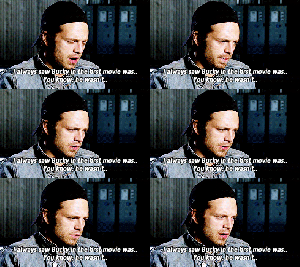
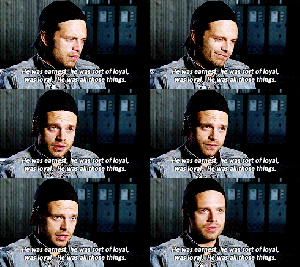
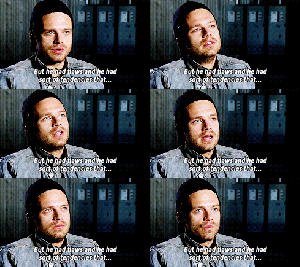
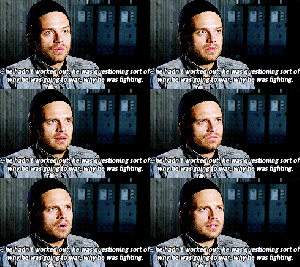
It’s also Bucky being more than a little upset that they turned his gentle, harmless friend—who Bucky wanted to PROTECT from the horrors of war—into a fighting machine.
was that really necessary
it’s also Bucky realizing that he can no longer protect his best friend no matter how hard he tries. he’s utterly helpless now, even after the war is over. they’ll always be wanting steve to fight this or that, and bucky won’t be able to do a darn thing to protect him.
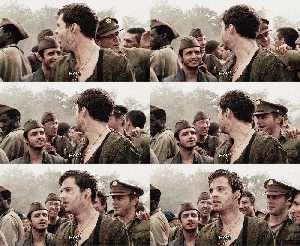
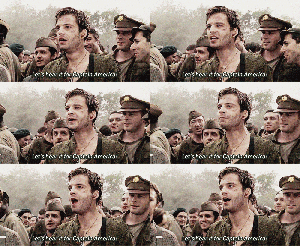
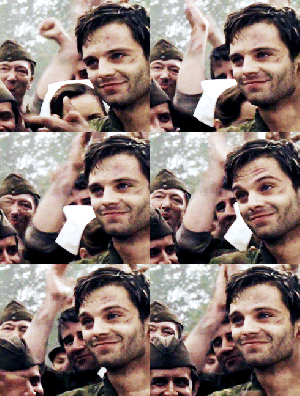
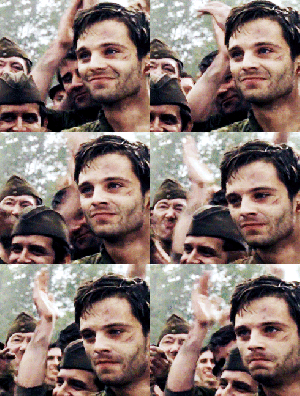
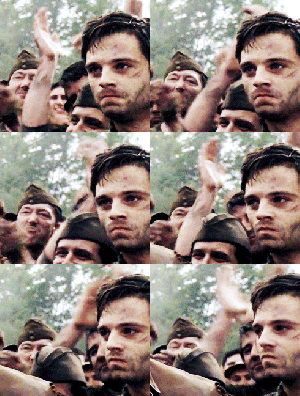
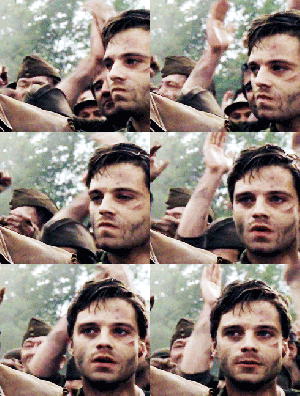
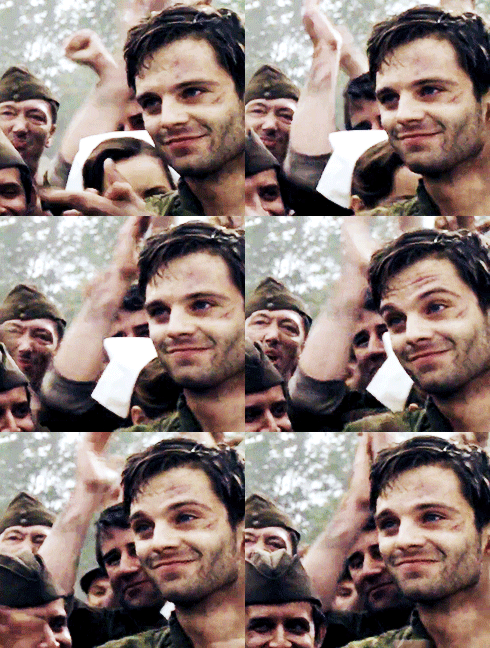
It’s also Bucky taking the 5 seconds he has of Steve not paying attention to him so he can allow himself to process all these emotions without worrying Steve. If you watch Bucky through the movies, you’ll notice he always makes sure to look like he’s 100% fine if other people are looking at him. Fighting with Steve, but smiling at their dates. Recently tortured, but walking confidently by Steve’s side. Basically a mess, but all “Let’s hear it for Captain America!” It’s a pattern, really. Even in the flashback in CATWS, you can see he looks a lot less confident when Steve isn’t looking at him than when Steve is.
Also, Seb has mentioned that researching WW2, what left the deepest impression was how quickly everybody dies. You get attached to someone only to watch their heads being blown up in front of you the next day. I’m sure this influenced how he chose to act this scene. Because you can bet by the time this scene takes place, Bucky has seen many people – hell, maybe even friends – die, and recently, he’s had to see his whole unit be killed or captured by HYDRA. This certainly plays a role here. It’s not just a general sense of “I can’t protect Steve anymore,” it’s more like “I don’t know if Steve will live till next week.” It’s very real, very immediate. It’s a concrete prediction more than a vague fear. And if Steve’s survives, there’s still the fact Bucky knows what’s like to be changed by war, and Steve will be changed by it, which Bucky certainly hates. Either way, he loses the Steve he knew, even more than he’s already lost, with the whole “Steve Rogers is suddenly a super soldier” deal.
I’d say this scene is wartime Bucky in a nutshell. He handles the entire crowd and this whole Captain America propaganda thing without hesitation, he smiles at Steve and makes sure Steve enjoys the moment instead of pulling some “I did my duty” bullshit, and only then he allows himself to be overwhelmed by the fear that comes with being able to think 48923740 worst case scenarios in two seconds. If we can trust interviews with cast and crew, this eventually becomes his role in the war, basically – he thinks fast and does his job protecting Captain America and the missions, he takes care of Steve on a personal level by shielding him from the worst of the war as much as he can, and only then, if there’s time and Steve isn’t looking, he thinks about how the war is affecting him.
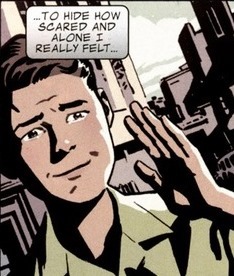
But anyway, overall, this scene is about overwhelming loss of everything Bucky knows, as well as an attempt to hide this as well as he can. And I don’t think it’s a coincidence that in the 4th and 5th gifs, Seb looks a lot like comics!Bucky does when he says goodbye to his younger sister, thinking he’ll never see her again and almost breaking down in tears, but unwilling to show her he’s scared. For your reference:
Chris Evans behind the scenes of the May 2016 Rolling Stone shoot
the tags on this were utter gems so here are some of my faves
Essay time y’all – cause these tags are truth. But one of my FAVORITE (and by favorite I mean the reason so many of his pictures fucking enthrall me) things about the way either he poses or the photographers pose him is that that the default for him doesn’t tend to be the WALL OF MAN imposing/daring someone to fuck with him poses that most photographers position men in, especially men who play superheroes. Far more often you see him posed as photographers often pose women – S-curves (trace a line from shoulders to hips to waist to knees in that pic – it’s a feminine way to pose), shoulders slightly hunched forward, looking at the camera through his eyelashes, mouth slightly open. They pose him to invite the viewer in instead of projecting out. The way they pose him is a type of masculinity that isn’t trying so fucking hard and y’all my LOINS ARE HERE FOR IT.
When I try to describe the type of masculinity that I find fucking appealing, it’s this.
(Look… y’all… if you haven’t seen his truckstop hooker photos from way back, do your loins a favor and find them)
A reminder that Sam Wilson was speaking out against the Accords before Steve even opened his mouth once.
A reminder that Bucky Barnes lived a full two years without Steve by his side. He found himself that place in Romania alone. He decorated it alone. He taught himself how to live again alone.
A reminder that Sam and Bucky love Steve very much, but to say that Steve is the catalyst for their actions is reducing the importance of them and taking away from their character traits unfairly.
A reminder that Sam and Bucky have agency outside of Steve.
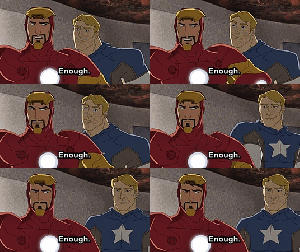
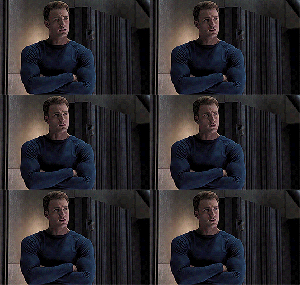
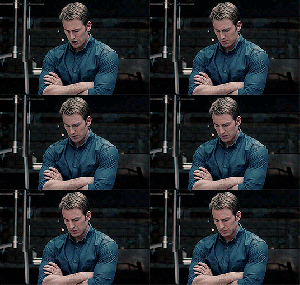
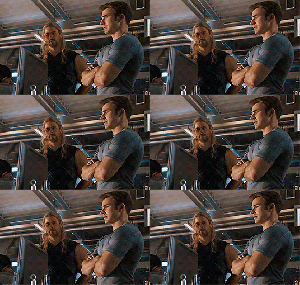
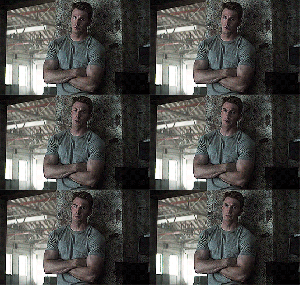
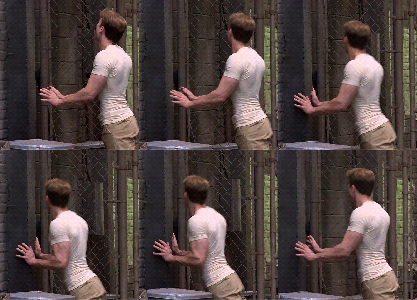
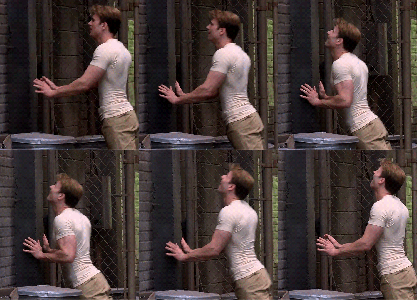
You can think this stance is Steve being stern, or showing off his arms (which I’m sure the producers of these movies love), but it’s really just Steve protecting himself.
Because what does Steve know how to do? Lead. Fight. He’s a soldier.
What is he doing in all these GIFs? Talking. Listening.
When he talks to Peggy Carter in Captain America: The First Avenger on their way to the lab where he’ll ultimately be transformed into the guy whose arms you can’t stop staring at, he remarks that their conversation is the longest he’s ever had with a woman.
You think Steve’s conversations with men were any longer? Outside of Bucky, MAYBE?
From personal experience I can tell you that there are different ways to cross your arms. What we see in this GIFset may just be a personal tic for Chris Evans that was accepted as a character choice for Steve Rogers. As someone who struggles with anxiety myself, crossing my arms is a way of protecting myself while trying to not look like I’m protecting myself. So maybe that’s what Chris is doing here.
Either way, look: he’s not pointing his elbows. He isn’t making a show of prowess with his arms; he’s guarding himself. This posture makes his arms wrap around his stomach and support his spine so that it’s not as difficult to stand-up straight–which is something that, when you do it, forces you to expose yourself, physically and emotionally.
This can make you look “tough” and “together” when really you’re just holding your body together.
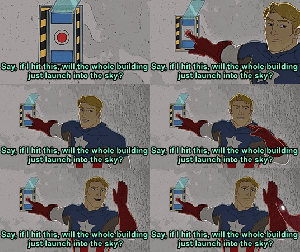
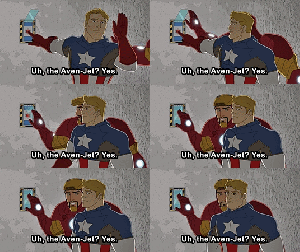
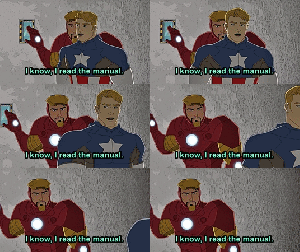
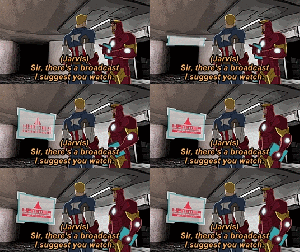
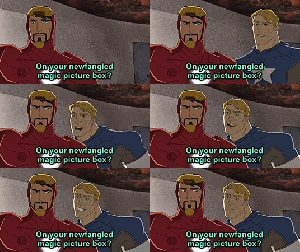
This is to say nothing of the fact that each and every one of these moments in the movies are moments of vulnerability, especially the reveal of Jarvis’ destruction by Ultron in Avengers: Age of Ultron (HELLO, Jarvis is artificial intelligence, a computer program, helpful and witty though he is, that Steve has sympathy for), comforting Wanda after the events in Nigeria in Captain America: Civil War, and, later in the same movie, talking to Bucky for the first time since they fought on the crashing Helicarrier in Captain America: The Winter Soldier.
Steve has broad shoulders and big arms; he is a specimen (to quote Erin [Aaron?]) of physical prowess; but let’s not forget that Steve’s heart was bigger than his body before his transformation, and was bigger after as well.
Steve never cared much for his body, which is why he had no problem standing up to that bully in the alley behind the movie theater, or going through basic training in the military, or throwing himself on what he thought was a live grenade to protect others. His heart is so big that he acts without thinking, throwing his body into danger to save others. But when no one immediately needs saving, when he just has to stand there and… be Steve, when his heart is just… exposed, what does he do?
There’s nothing new about the consideration of male superheroes as icons of masculinity. Superman representing the pinnacle of wholesome, idealised masculine power, or The Hulk as an allegory for the angry, repressed male id. And these types of masculinity are not innate or inevitable. Masculinity, like all gender roles is a socially constructed performance.
But performative masculinity has a tension to it that performative femininity does not, because performing itself is seen as innately unmasculine. You cannot learn to be a real man, you are or you are not. You can’t make one or learn to be one. Because our story about masculinity is that it just is. It is an ur state of being. The most natural way for a human to be.
Steve Rogers came out of a bottle.
And Steve Rogers’s weapon is a shield. Steve does not attack, he defends. Steve Rogers is the only Avenger who does not thrust forward with a phallic weapon. From Loki’s staff to Clint’s arrows, Black Widow (who pairs so well with Steve because she is a phallic woman) has guns, Tony essentially is a giant penis (sorry, friends, that’s all I see), and of course no one would even pretend that Thor’s hammer isn’t Thor’s penis.
But Steve has a shield. And a shield isn’t particularly feminine. It is not a cup or a sheath or a hole. It is just anti-phallic.
And that is Steve. the non-phallic man. Because you can’t make a man in a machine. Only a strange kind of monster.
















 hannahbelleeeebackup